Summarize Written Text 2026: The 'One Perfect Sentence' Rule
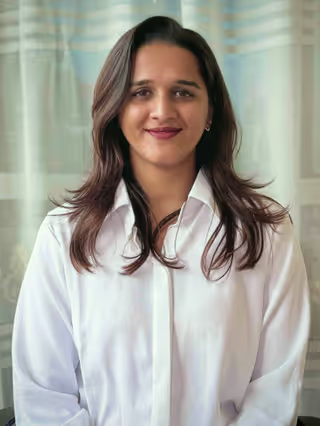
By Smriti Simkhada (90/90) · Updated
Quick answer: In PTE Academic Summarize Written Text (SWT), your response must be one complete sentence of 5-75 words: a capital letter at the start and one full stop at the end. Two sentences, fewer than 5 words or more than 75 words give Form 0, and Pearson then scores the whole response zero, not just the Form mark.
Below: what counts as one sentence, a 74-word vs 76-word worked example, the compound-complex template, and how to repair a two-sentence draft in the last minute. For the wider plan, see how to score 79+ in PTE Academic.
The Summarise Written Text (SWT) one-sentence rule is the most broken rule in PTE Academic Writing. Students who understand the passage well still lose the whole task because they finish one sentence and start another, sometimes without noticing. This guide covers what Pearson actually requires, what happens at the edges of the rule, and how to build a single sentence that carries the main idea and its support.
The Rule in One Line
Your entire SWT response must be one sentence of 5 to 75 words. Pearson's test tip says to check that it is "only one sentence, with a capital letter at the beginning and only one full stop at the end." Pearson's format page adds: "If you write fewer than five words or more than 75 words, your response will not be scored."
Pearson's Score Guide lists two SWT items in each PTE Academic test. Each gets 10 minutes and a passage of up to 300 words that stays on screen.
Stuck below your target? The 79+ Sprint
Private 1-on-1 coaching, from US$99: pick 7 days, 17 days or 1 month, one live session a day at a time that suits you, a demo session included, and Coach-Until-Target on the longer plans.
Why the Rule Is Strict
SWT is scored on four traits: Content (0-4), Form (0-1), Grammar (0-2) and Vocabulary (0-2), so 9 trait points in all. Form has only two levels:
- Form 1: "Is written in one, single, complete sentence."
- Form 0: "Not written in one single, complete sentence or contains fewer than 5 or more than 75 words. Summary is written in capital letters."
The part many guides miss is what Form 0 does to the rest. Pearson's Score Guide: "When the response is scored as 0 for Content or Form, no score points for the response will be given." So a two-sentence summary does not lose one point out of nine. It loses all nine.
There is a second route to zero. If your summary misreads the topic or purpose of the passage, Pearson gives no points "on any of the four factors."
Source: Pearson PTE Academic speaking & writing format and the PTE Academic Score Guide (Test Taker, 2025) via pearsonpte.com/pte-academic/scoring. Last verified 2026-10-02.
What Counts as "One Sentence"
One sentence has:
- One capital letter at the start.
- One full stop at the end, and no full stop, question mark or exclamation mark in between.
- At least one main (independent) clause, with any number of subordinate or relative clauses joined to it.
Joins that keep you inside one sentence: conjunctions ("and", "but", "while", "although", "because"), relative pronouns ("which", "that", "who"), participle phrases ("leading to", "resulting in") and appositives ("a process that...").
Pearson's Grammar descriptor notes that "the best responses usually consist of a main clause and subordinate clause." That is the shape to practise.
Worked Examples
Wrong (two sentences, whole response scores zero)
"Climate change is causing significant damage to global ecosystems. Governments need to respond urgently with coordinated policy reform."
Right (one sentence)
"Climate change is causing significant damage to global ecosystems, which requires urgent government response through coordinated policy reform and international cooperation."
Same ideas. The second version uses "which requires" as a relative clause instead of starting a new sentence.
Risky (comma splice)
"Climate change damages ecosystems, governments must respond."
Two independent clauses joined only by a comma is a comma splice. Pearson does not say whether its engine reads this as one sentence or two, but it is a grammar error either way. Do not test it on exam day.
Right (clean compound)
"Climate change damages ecosystems, and governments must respond with coordinated policy."
The "and" makes this a valid compound sentence.
At the Boundary: 74 Words vs 76 Words
This is the example a search snippet cannot show you. Here is one summary at 74 words:
"While a large study of residents in several European cities found that regular access to urban green spaces such as parks and streets lined with trees improves mental health outcomes, including lower reported stress and anxiety, the effect was noticeably stronger in densely populated neighbourhoods where private gardens are rare, which suggests that urban planners should treat park access as a public health measure and prioritise new green space in the most crowded districts."
At 74 words it is one complete sentence, so Form is 1 and Content, Grammar and Vocabulary are all scored. Now add two words during proofreading, "several European cities and suburbs", and it becomes 76 words. Nothing else changes, but the response is no longer scored. Two words turn a full-credit attempt into zero.
That is why a 74-word answer is not a safe target, even though it is legal. Long sentences also strain grammar: the more clauses you stack, the easier it is to lose subject-verb agreement.
The 2026 SWT Formula — Compound-Complex Template
A compound-complex sentence handles most passages: one main clause, one or more dependent clauses, joined cleanly.
"While [main idea from the passage], [secondary point or supporting detail], which [conclusion or implication]."
It uses subordination ("while"), a supporting clause and a relative clause for the conclusion.
Worked example
Passage topic: A study finds that urban green spaces improve mental health outcomes, with effects more pronounced in densely populated cities, suggesting urban planners should prioritise park access.
SWT response: "While urban green spaces have been shown to improve mental health outcomes, the effect is more pronounced in densely populated cities, which suggests that urban planners should prioritise park access in dense areas."
Word count: 33. One sentence. Covers all three main ideas. You can stop here, or add one supporting detail to reach the 55-65 range.
Alternative Templates When the Passage Has Two Distinct Points
If the passage has two parallel points without a clear cause-effect link:
"The passage explains that [point 1], and also notes that [point 2], indicating that [overall conclusion]."
For passages built on a contrast:
"Although [point 1 or initial belief], the passage argues that [counter-point], which suggests that [implication]."
Pick the template that matches the passage. Forcing every passage into one memorised frame produces awkward sentences, and Pearson's Content descriptors reward paraphrase over repeated excerpts from the source.
Tools for Extending One Sentence Within the 5-75 Word Range
- Relative clauses: "...which shows / which suggests / which indicates..."
- Participle phrases: "...leading to / resulting in / contributing to..."
- Subordinating conjunctions: "...although / while / whereas / because / since..."
- Coordinating conjunctions with commas: "...and / but / so / yet..."
- Appositives: "...a process that... / a factor which..."
- Richer noun phrases: adding detail around a noun ("a ten-year study of 2,000 residents") without adding a clause.
The flexible writing templates include more SWT extension patterns.
Last-Minute Repair: What to Do If Your Draft Breaks the Rule
- Two full stops: change the first full stop to ", which" or ", and", and lower-case the next word. Read it once to check it still makes sense.
- 76 words or more: delete one adjective string or one secondary detail clause. Nothing above 75 is scored, so this comes before any grammar check.
- Question mark inside the summary: rewrite the question as a statement ("the passage asks whether..." becomes "the passage examines whether...").
- Caps lock left on: retype. A summary in capitals gets Form 0.
- Under 5 words: rare, but it happens when time runs out. Write the passage's main idea as one plain sentence.
Step-by-Step SWT Execution Strategy
- Minutes 0-3, read for the spine: find the topic sentence and the conclusion. They are often, but not always, the first and last sentences.
- Minutes 3-4, find the logic: cause-effect, comparison, contrast or sequence. This decides the template.
- Minutes 4-7, build the sentence: aim for 55-65 words.
- Minutes 7-9, proofread: articles, subject-verb agreement, tense, word count.
- Minutes 9-10, final pass: count the full stops. There should be one.
Target Word Count Within the One Sentence
Pearson's range is 5-75 words. Inside that range Form is met; there is no "50-word minimum."
- Under 5 words: Form 0, response not scored.
- 5-30 words: Form 1, but usually too thin to cover the supporting points that Content rewards.
- 30-54 words: Form 1. Fine for a short passage with one clear argument.
- 55-65 words: our coaching target. Room for the main idea, two supporting points and an implication.
- 66-75 words: Form 1, but one proofreading addition can push you over.
- Over 75 words: Form 0, response not scored.
How One-Sentence SWT Connects to Your Writing Score
SWT is a cross-module task: Pearson counts it for Reading and Writing. A clean one-sentence response helps both, and a broken one costs both. Summarise Spoken Text works the same way for Listening and Writing, but it allows several sentences and has a 50-70 word target instead.
Taking PTE Core rather than Academic? Core's Summarize Written Text is a 25-50 word summary. Pearson's Core format page says responses outside that range are not scored; its Core Score Guide 2026 lists a reduced Form band at 5-24 or 51-60 words and zero only below 5 or above 60. The two documents disagree, so treat 25-50 as the rule. The Academic one-sentence, 5-75 word rule does not carry over.
Common Mistakes Nepali Students Make
- Writing two sentences. Still the most common SWT error. Practise until one sentence feels normal.
- Comma splices. Nepali joins clauses differently, and "X, Y" without a conjunction feels natural to many students. In English it is an error.
- Overlong sentences that lose grammar. A 72-word sentence with agreement errors scores lower on Grammar than a clean 55-word one.
- Copying whole sentences from the passage. Pearson's top Content band asks for paraphrase. Keep key terms, change the structure.
- Ignoring word limits on other tasks. The essay and SST have their own bands and zero lines.
"I had been writing two sentences without realising it for three attempts. The fix took 15 minutes of explanation — Reading and Writing both moved up the next time." — Pranisha K., Kathmandu
"Once I started using 'which requires' and 'leading to' instead of starting new sentences, my SWT became natural. The grammar got cleaner because I was not rushing transitions." — Saroj A., Pokhara
Results reflect individual student preparation experience. Scores depend on personal effort, starting ability, and test conditions. No specific outcome is guaranteed.
Frequently Asked Questions
What if the passage has multiple disconnected ideas?
Make the most important idea your main clause and attach the others as subordinate clauses. You do not need every point; Pearson's Content criterion asks for the main idea and essential supporting points.
Are semicolons allowed in SWT?
Pearson's rule is one capital letter and one full stop, and it does not mention semicolons. Grammatically, a semicolon keeps you in one sentence. A subordinating conjunction is still the safer choice because it shows the logical link.
Does SWT have its own published score?
No. SWT feeds your Reading and Writing scores rather than appearing as a separate line on your score report.
Can I use bullet points or numbered lists in SWT?
No. A list is not a single complete sentence, so it fails Form, and the response scores zero.
Conclusion: Build Your PTE Writing Score
SWT comes down to one sentence, 5-75 words, one full stop. Break any part of that and the whole response scores zero. Aim for 55-65 words, use a main clause plus subordinate clauses, and count your full stops before you move on.
Pair this with the flexible essay framework and common grammar mistakes to avoid. To find out whether SWT or another task is holding your score back, book a free score assessment, or have the team of Smriti Simkhada mark your SWT sentences in the 1-on-1 coaching program.
Source: Pearson, PTE Academic test format: Speaking & Writing and the PTE Academic Score Guide (Test Taker, 2025). Last verified: 2026-10-02. Pearson can change SWT rules; check the official page before your test.

About Smriti Simkhada
Smriti Simkhada is a PTE Academic perfect scorer (90/90) providing structured PTE coaching for Nepali students. She and her team have helped 1,500+ students prepare for Australia PR and Canada immigration through structured, criteria-aligned coaching.